RB CV

Case Studies

Senior Data Analyst · Dublin · Immediately available

Operational problems defined, workflows redesigned, measurable impact delivered.

Operational Problems I Solve

The pattern across 15+ years — Root causes diagnosed & fixed


Every project below started with a structural failure — something breaking quietly, absorbing operational cost, or producing unreliable outcomes. The work was always the same: find the root cause, redesign the system, deliver the fix.

1 of 4

Selected Work

Four distinct failures.
One consistent operational methodology.

"I identify hidden failure points and turn them into clearer workflows, stronger controls, and better decisions."

01 /

Diagnosis

The structural failure — what was breaking and what it was absorbing.

02 /

Re-engineering

The redesign logic — how the system was rebuilt to hold under pressure.

03 /

Metrics

What changed — execution time, cost, data volume, or failures eliminated.

2019

Case Study 01

ServiceNow REST API Automation · From Manual Bottleneck to Sub-Second Ticket Creation

REST API · Process Automation · Global Rollout · APAC · LATAM · EMEA

Global ServiceNow Automation (Fixed Income)


APAC · LATAM · EMEA · Excel VBA · REST API · ServiceNow

A bottlenecked, email-based ticketing system across three global regions was creating submission failures, overloading the email server, and generating approximately one minute of processing time per ticket. The structural problem was not volume — it was architecture. The system was never designed for concurrent, high-frequency submission at scale.

The Problem

Thousands of simultaneous submissions via Excel and Outlook macros were overloading the email system. Each ticket took approximately 1 minute. No pre-submission validation. No confirmation on receipt. Failures were silent.

The Redesign

Built a master Excel template with direct REST API integration, a centralised dropdown database, pre-submission field validation returning the exact mismatching line, and automatic ticket number and URL return on confirmation.

The Outcome

Ticket processing reduced from approximately 1 minute to sub-second execution. Zero manual verification. Adopted across APAC, LATAM, and EMEA. Delivered under urgent timelines with live production issues resolved in real time.

Delivery ownership

I owned the full delivery cycle: mapping the process with analysts, bridging requirements with IT, self-teaching the REST API integration, coding the solution, testing the templates, validating results, supporting rollout, and measuring against acceptance criteria.

During rollout, different teams requested conflicting enhancements. I prioritised based on operational value, controlled scope to prevent delivery drift, and managed expectations while keeping adoption momentum across three regions.

Before vs After · Infographic
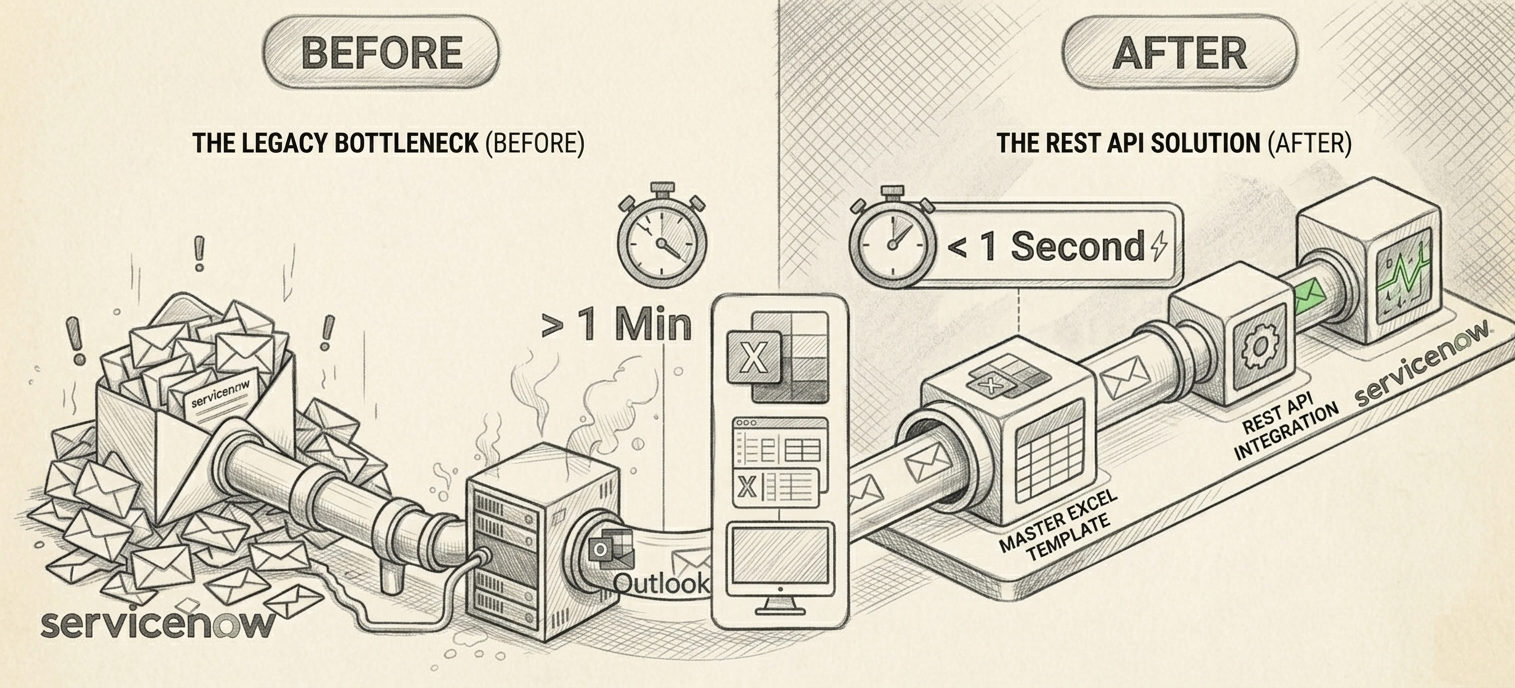

Legacy bottleneck to REST API solution
ServiceNow before and after infographic

Engineering and Architecture

  • Replaced per-team Excel and Outlook workflows with a single REST API-integrated master template connecting directly to ServiceNow
  • Built a centralised dropdown database so all market templates updated automatically from one change
  • Developed pre-submission validation returning the exact line and field mismatching ServiceNow requirements
  • Returned live ticket numbers and direct URLs on submission, eliminating manual verification entirely

Market-Specific Solutions

  • Designed customised templates for Luxembourg SE, NSD, Bolsas y Mercados Españoles, and Deutsche Börse AG Bonds
  • Delivered separate templates for Frankfurt, Japan, and Hong Kong where market-specific structures required different handling
  • Built market-specific data extraction tools to auto-populate required ticket fields from announcement paste
  • Balanced global standardisation with local market flexibility through a scalable master template model

Delivery Under Pressure

  • Self-taught REST API integration, navigated IT cybersecurity approval, and delivered under urgent project timelines
  • Resolved live production issues in real time while keeping the running process visible and stable
  • Controlled scope and prioritised enhancements when different teams requested conflicting changes

Technical Workflow · Before vs After
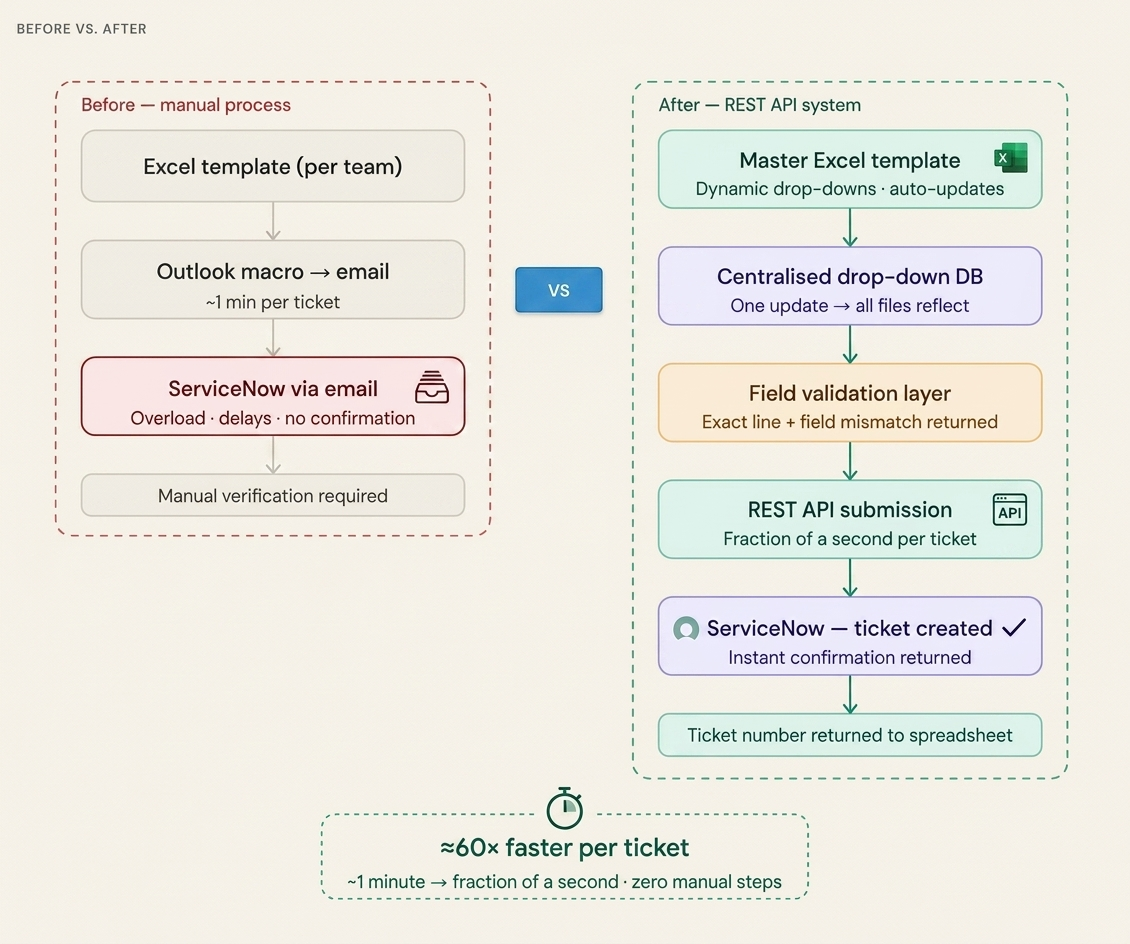

System architecture · manual process vs REST API solution
Technical workflow before vs after
2022

Case Study 02

Multi-Market Governance & Validation Framework · Germany External Data Vendor

Data Governance · Validation Framework · 35,000+ Daily Securities · RDO Operations & BA Teams · Dublin · US · India

Integration and Governance: Germany External Data Vendor


Oracle SQL · Access · Tableau · Jira · ETL · Reconciliation Logic

The onboarding of a new external data vendor at scale created a governance problem: 35,000+ securities daily with no validation framework, no source hierarchy, and no reconciliation logic between production and test environments. Bad data reaching the live system would have direct downstream impact on custody and fund accounting processes. I owned the end-to-end technical investigation and governance design, applying structured business analysis to map the problem space, define validation requirements, and align resolution across BA and operations teams.

The Problem

Large-scale onboarding of 35,000+ securities daily with no validation framework, no source hierarchy, and inconsistencies across production and test environments — creating systemic risk of unvalidated data reaching live systems.

The Redesign

Designed a validation framework, source hierarchy rules, and production vs. test reconciliation logic. Built SQL and Access tracking database, Tableau dashboards for stakeholder visibility, and an automated data feed end to end.

The Outcome

Structured validation process governing 35,000+ daily securities with clear error ownership, prioritisation by systemic impact, full stakeholder visibility, and governance logic adopted across global teams.

Validation and Contribution Flow


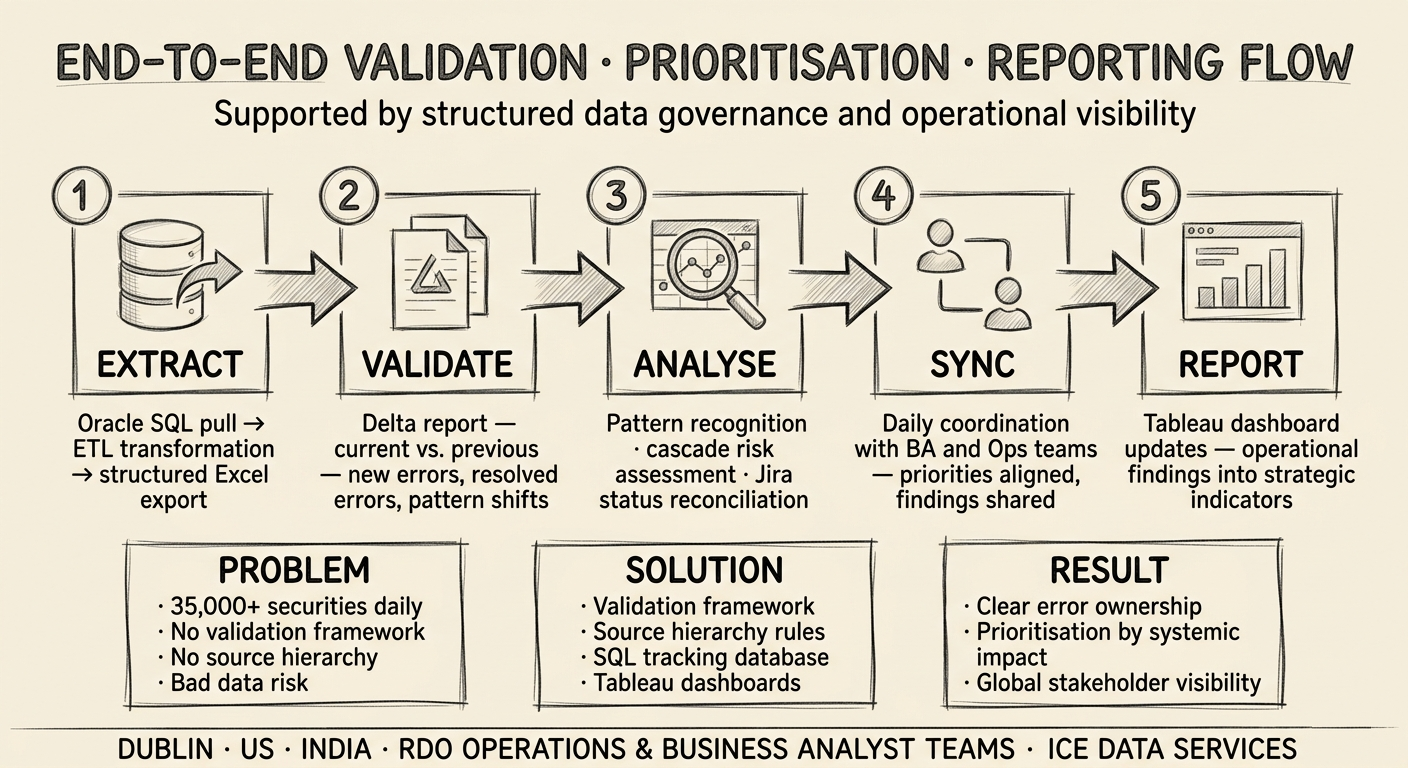
End-to-end extract, validate, analyse, sync, and report cycle — supported by structured data governance and operational visibility.

1

Extract

Oracle SQL pull, ETL transformation, and structured Excel export ready for analysis.

2

Validate

Delta report comparing current vs. previous file, identifying new errors, resolved errors, and pattern shifts.

3

Analyse

Pattern recognition by security type, cascade risk assessment, and Jira status reconciliation to build the prioritised backlog.

4

Sync

Daily coordination with BA and Ops teams to agree on priorities, share findings, and align on resolution approach.

5

Report

Tableau dashboard updates for senior stakeholder and PM visibility, translating operational findings into strategic progress indicators.

Reporting Flow


End-to-end validation · prioritisation · reporting flow
Germany external data vendor reporting flow

Data Validation and Quality Assurance

  • Validated 35,000+ daily security records across multiple asset classes
  • Performed production vs. test reconciliation isolating the source of mismatches
  • Validated vendor data against issuer-level records and ISIN structures

Data Governance and Source Hierarchy

  • Designed source hierarchy framework to resolve overwrite conflicts
  • Built structured triage methodology based on cascading error impact

Reporting, Database and Automation

  • Built SQL and Access database for error tracking and reporting
  • Delivered dashboards providing real-time operational visibility
  • Designed and maintained automated data feed end to end

Project Coordination

  • Coordinated delivery across RDO and BA teams using Jira
  • Translated operational findings into structured business recommendations
2009

Case Study 03

Digital Invoice Transformation · SulAmérica · 2009

Finance Operations · Cost Reduction · Process Redesign · Brazil · Before it was standard

Digital Invoice Distribution · Before it was standard


Finance Operations · Process Redesign · Regulatory Compliance · Cost Reduction

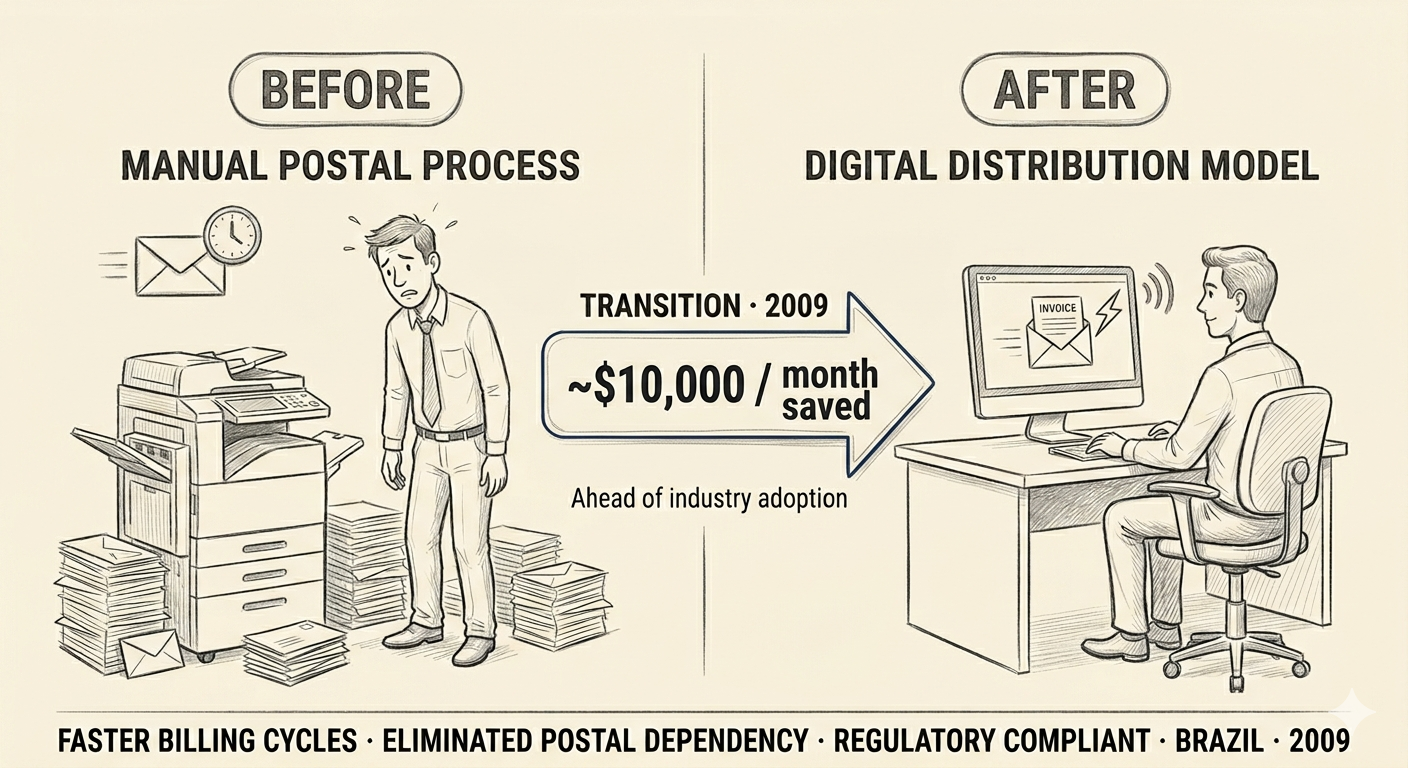
In 2009, invoice distribution at SulAmérica relied entirely on postal delivery — high cost, slow billing cycles, and heavy manual dependency. Digital distribution was not yet standard practice in Brazilian health insurance. The problem was not a lack of technology. The problem was that nobody had mapped the cost, redesigned the process, or challenged the assumption that postal distribution was required. I identified the inefficiency, structured the business case, and redesigned the delivery model while ensuring compliance with the health insurance regulator throughout.

The Problem

Invoice distribution relied entirely on postal delivery, creating high per-unit cost, slow billing cycles, and manual dependency at a time when digital alternatives were not yet widely adopted in the sector.

The Redesign

Redesigned the delivery model to digital distribution using existing system capabilities, eliminating physical mail, automating delivery, and ensuring full compliance with Brazil's health insurance regulator throughout the transition.

The Outcome

  • Approximately R$20,000/month cost reduction (roughly US$10,000 at the time)
  • Accelerated billing cycles
  • Removed manual processing dependency
  • Digital-first model established years ahead of sector adoption

Process Transformation · Before vs After


Manual postal process to digital distribution model · 2009
Digital invoice distribution infographic

Why this matters

This project reflects an early pattern in my work: identifying where manual processes create unnecessary cost, redesigning them using available capabilities, and delivering the change through structured analysis rather than tool adoption for its own sake.

The solution was not driven by technology enthusiasm. It was driven by cost mapping, process analysis, and a clear understanding of what the regulator required and what it did not. That distinction — between what is structurally necessary and what is legacy assumption — is what creates the space to redesign.

2026

Case Study 04

Recruiter-Facing Decision Architecture · Professional Positioning Platform

Decision System Design · Requirements Structuring · AI-Assisted Delivery · Career Re-entry · Dublin · 2025–2026

Professional Positioning Platform


Business Analysis · Delivery Ownership · Structured Communication · AI-Assisted Build

In an application environment where AI-assisted CVs have reduced the signal value of self-description, I approached re-entry as a structured operational problem: the recruiter is the decision-maker, the employment gap is an objection requiring a structured response, and the platform is the decision architecture. I designed this site the same way I approach any operational problem — start with the stakeholder's decision flow, identify where friction or ambiguity exists, and design a system that removes it.

Live platform: rafabaltazar.com

The Problem

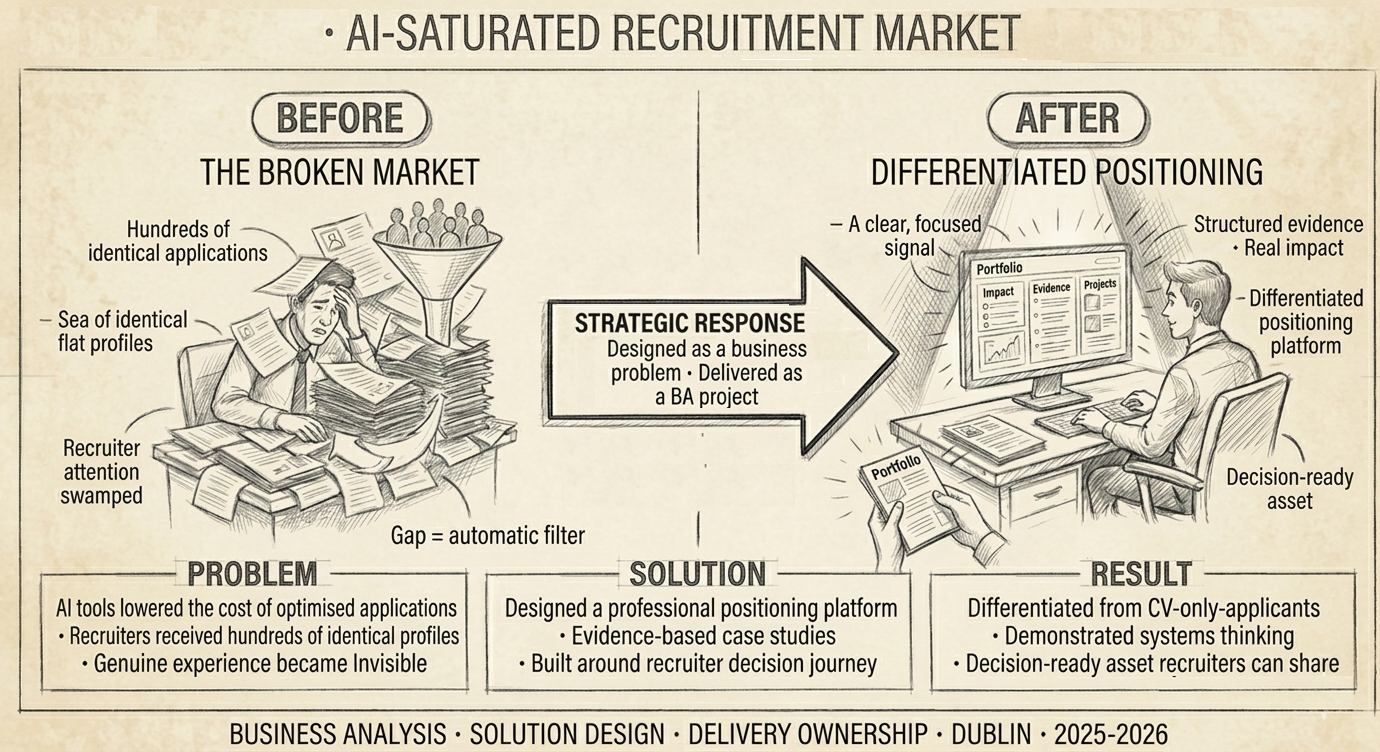
In a high-volume hiring environment, AI-assisted applications reduced the cost of optimisation. Recruiters scan faster. Employment gaps are filtered before they are explored. CV claims are indistinguishable from generic positioning. Depth of evidence is buried.

The Redesign

Designed a multi-page professional platform structured around the recruiter's decision flow. Structured requirements, shaped content architecture, managed delivery using AI tools for build support, and deployed the system as a live, shareable asset.

The Outcome

A live decision-ready asset that differentiates from CV-only applications, addresses the employment gap directly through structured evidence, and demonstrates delivery ownership, structured thinking, and operational judgement in a verifiable format.

Analysis and design logic

  • AI reduced the cost of producing optimised applications — increasing noise, reducing signal
  • Recruiters increasingly rely on fast scanning and pattern recognition
  • Employment gaps are filtered before being explored in conversation
  • Operations and BA professionals underuse portfolio-style evidence compared with technical roles
  • Applied business analysis methodology — problem framing, requirements structuring, stakeholder decision flow mapping — to shape the platform architecture

Delivery approach

  • Separated About, Experience, Portfolio, and Contact into distinct decision layers
  • Translated 15+ years of experience into Problem, Redesign, Outcome case studies
  • Used AI-assisted workflows to support HTML/CSS structure, UX iteration, content refinement, and communication clarity — retaining full delivery and requirements ownership throughout
  • Purchased domain, selected hosting, deployed through Netlify, reviewed the live experience

Platform · Overview


Recruiter-facing decision architecture · live platform
Candidate positioning platform overview

Discovery

Defined recruiter decision flow, information gaps, and limitations of standard CV positioning.

Architecture

Designed a four-page structure based on decision value, evidence layers, and reading flow.

Content

Converted 15+ years of experience into structured case studies and recruiter-facing evidence.

AI-assisted build

Used AI tools to support HTML/CSS structure, layout iteration, content refinement, and quality review.

Launch

Purchased domain, deployed through Netlify, reviewed the live experience, linked across applications.

The common thread

What these case studies demonstrate


Across different industries, business contexts, and levels of complexity, the pattern is consistent: I identify where systems break, structure the problem clearly, and deliver practical redesigns that improve visibility, control, speed, and decision quality.

These projects reflect how I approach process improvement, business analysis, workflow redesign, automation, and stakeholder communication — always with a focus on measurable operational outcome rather than technical activity.

Recruiter FAQ